
Polyaspartic vs. Epoxy Floor Coatings in the Willamette Valley
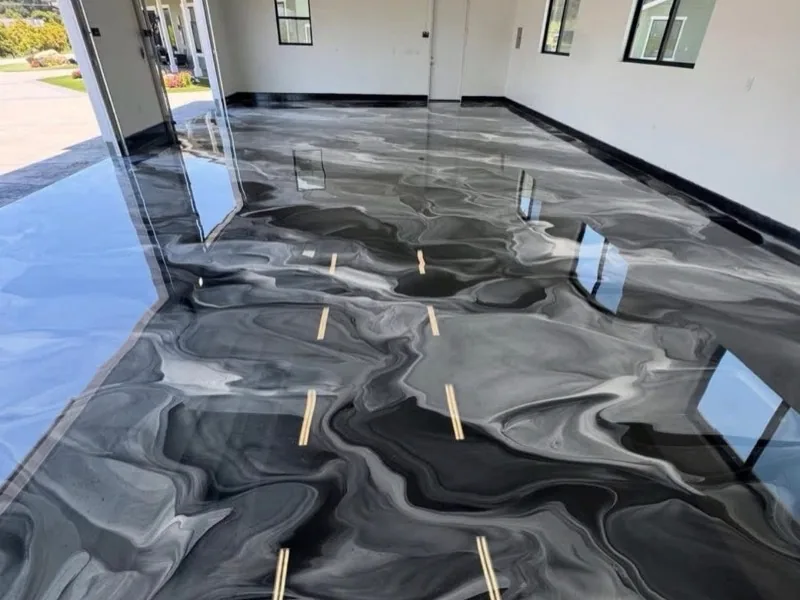
Quick answer: Epoxy is a hard, thick, economical base that bonds well and resists chemicals but can amber in sunlight; polyaspartic is a UV-stable, fast-curing coating that stays clear and can go down in cooler conditions but costs more and has a short working time. In the Willamette Valley, the most common professional build is an epoxy base with a polyaspartic topcoat, especially for sunny garages, patios and shops with big doors. Call (541) 960-4797 for a recommendation for your floor.
The short version
Epoxy and polyaspartic are both two-part resin coatings, and both are used on garage and shop floors, but they behave differently. Epoxy is the workhorse: strong bond, good build, lower cost. Polyaspartic is a type of polyurea, chosen mostly for the topcoat because it resists UV yellowing and cures within hours. The best system for a given floor is often both used together.
Side-by-side
| Epoxy | Polyaspartic | |
|---|---|---|
| Cure time | Slower; often a day or more before light traffic | Fast; often hours to walkable |
| UV stability | Can amber or yellow in sunlight (unless topcoated) | UV-stable; stays clear |
| Working time | Longer, more forgiving to apply | Short; requires skilled crews |
| Temperature range | Needs cool-to-warm, dry slab; poor in cold | Cures over a wider range, including cooler temperatures |
| Adhesion / body | Excellent bond and build | Excellent topcoat; often used thinner |
| Cost | Lower material cost | Higher material cost |
| Best use | Base coats, shops, interior floors | Topcoats, patios, sunny garages, fast-turn jobs |
Cure times and temperature limits vary by product; the manufacturer's technical data sheet governs.
Where each makes sense in Albany
- West- or south-facing garages and open doors. Summer sun through the door can yellow an epoxy topcoat. A polyaspartic clear coat resists that.
- Patios, porches and walkways. Outdoor UV exposure makes UV-stable topcoats the sensible choice. Outdoor slabs also see more moisture, so testing still matters.
- Interior basements and shops. Epoxy alone is usually fine because there is little UV. See interior floors.
- Cold-season installs. Polyaspartic tolerates cooler conditions better, which helps in Albany's wet, cool winter, though a slab still has to be dry and above the dew point.
- Businesses that cannot close. Fast return-to-service can be worth the premium; see commercial epoxy flooring.
The hybrid: epoxy base, polyaspartic topcoat
A common professional build is a ground slab, a moisture-aware primer, an epoxy base coat, broadcast flakes and a polyaspartic clear. The epoxy gives body and adhesion at a sensible cost, and the polyaspartic gives UV stability, scratch resistance and a hard, glossy top layer that resists hot-tire pickup. It also speeds the schedule, since the topcoat cures quickly.
We use the same approach for flake floors and metallic floors where sunlight or wear justifies it.
Downsides to know about
- Short working time. Polyaspartic can gel in minutes, especially in warm weather, so poor application leaves lap marks or bubbles. Crew skill matters.
- Cost. Materials are pricier; the cost guide explains general ranges.
- Not a moisture cure-all. Neither one fixes a damp slab. See the moisture guide.
- Odor and fumes. Both have some odor during install; ventilation is required.
How we recommend
We look at the floor and the light. If the sun hits the slab, we lean to a polyaspartic topcoat; if the room is indoors and shaded, we usually keep it simple with epoxy. We put the choice in writing with the reason. If you are weighing an epoxy system against paint at all, read epoxy vs paint first.
What Oregon's wet climate means for this choice
In drier climates the polyaspartic versus epoxy debate is mostly about cure speed and UV. In the Willamette Valley, moisture comes first. Polyaspartic is a very fast-curing coating with a short working time, so it gives less opportunity to penetrate a slab and is less forgiving of damp concrete as a first coat. That is why most valley installs we recommend use an epoxy or moisture-tolerant primer as the base, after a moisture test, and save polyaspartic for the topcoat where its hardness, UV stability and quick return to service pay off. If a slab tests high for moisture, the conversation shifts to vapor-mitigating primers rather than topcoat choice.
Frequently asked questions
Is polyaspartic better than epoxy?
It is better in some ways (UV stability, cure speed, cold-weather use) and worse in others (cost, short working time). The strongest systems often combine the two.
Does epoxy turn yellow?
Some epoxies amber with UV exposure. Garages with little direct sun are less affected. A polyaspartic topcoat prevents it.
Can polyaspartic go over old epoxy?
Often yes, if the epoxy is well bonded and properly scuffed or ground. We assess each case.
How fast can I drive on polyaspartic?
Fast-cure systems may allow foot traffic within hours and vehicles the next day, but follow the written times for your product and conditions.
Is polyaspartic better than epoxy on damp Oregon concrete?
Not as a first coat. Damp slabs need a moisture test and usually an epoxy or vapor-mitigating primer; polyaspartic works best as the topcoat.
Related pages
Ready for a straight answer on your floor? Call or text (541) 960-4797 or send the quote form for a free on-site estimate.
Call (541) 960-4797