
Garage Floor Coating in Albany, Oregon
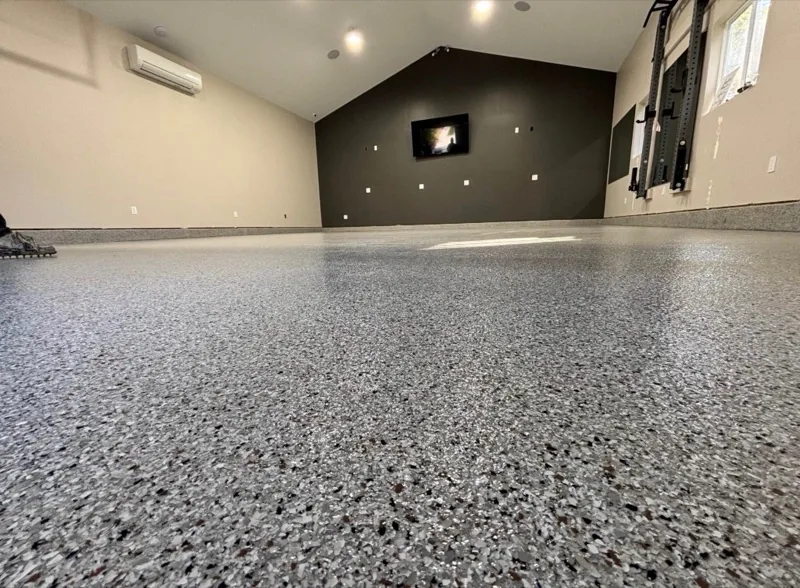
Quick answer: A professional garage floor coating in Albany is a diamond-ground concrete slab sealed with a two-part epoxy or polyaspartic system, usually a flake broadcast that hides dirt and adds grip. Most one- to three-car garages take one to three days on site. Prep is what decides whether the floor lasts, and in the wet Willamette Valley that includes a moisture check. We quote every floor in writing after a free visit; call (541) 960-4797.
What a garage floor coating actually is
Bare garage concrete is porous. It drinks oil, road salt residue, antifreeze and the tannin-brown water that drips off a wet car in January, and it throws off fine dust every time a tire turns. A garage floor coating closes that surface. Albany Epoxy grinds the slab, repairs it, and builds a seamless, sealed floor on top: a primer or base coat, a decorative layer if you want one, and a tough clear topcoat that takes the wear.
That is very different from the “garage floor paint” sold in a can at a home center. Those products are thin, usually one-part, and are the coatings that peel under hot tires. If you are weighing the two, our guide to garage epoxy vs paint lays out the differences in plain terms, and the cost guide explains why the prep, not the color, drives the price.
Garage floor systems we install
- Full-flake epoxy. A colored base coat, vinyl flakes broadcast to rejection, and a clear topcoat. It is the most popular residential system because the flake pattern camouflages tire marks, leaves and grit, and the texture gives wet boots something to grip. See flake epoxy floors.
- Metallic epoxy. Pigments are worked through the wet resin to create swirls that look like marble or moving water. It is a showpiece finish for finished garages, man-caves and detached shops. See metallic epoxy floors.
- Solid-color epoxy. A clean, single-color floor, often chosen for workshops and for anyone who wants the plain, bright look of a showroom garage.
- Polyaspartic topcoats. A fast-curing, UV-stable clear coat that can be laid over an epoxy base. It is worth considering when the garage door faces west or the door stays open in summer. See polyaspartic vs epoxy.
Why Albany garages need more than a good-looking finish
The mid-Willamette Valley gets roughly 40 inches of rain in a typical year, most of it between October and May. Cars come in soaked, the garage door seal is rarely perfect, and slabs sit on wet clay soil for half the year. That combination causes the problems we see most: white mineral bloom on the concrete surface, damp patches near the walls, and older coatings lifting in sheets because moisture pushed up from below.
Before anything is mixed, we look at the slab for those signs and talk honestly about them. Our wet-climate and moisture guide explains the concrete moisture tests professionals use, why an under-slab vapor barrier matters, and what can be done when a slab is wetter than a standard epoxy will tolerate. A decorative coat cannot hold back water that is pushing from underneath; a floor that will last is one where that question was asked first.
Winter temperature matters too. Epoxy cures poorly on a cold, damp slab, and a coating needs a slab that is comfortably above the dew point. Albany's winter days often stay in the 40s, so cold-season installs are planned around heat, ventilation and cure times rather than squeezed in on a marginal day.
Older Albany homes and their slabs
Albany has one of the more substantial collections of historic homes in the valley, with the Monteith and Hackleman historic districts near downtown. Many houses in those neighborhoods, and in the older parts of East and South Albany, were built long before modern practice put a plastic vapor retarder under every garage slab. Garages on those homes are often later additions or detached carriage-house style buildings, sometimes with hairline cracking, patched sections, old oil stains, or a slab that slopes toward a door.
None of that rules out a great floor. It does mean we look at each slab individually, repair cracks and spalls properly, note any active movement honestly, and spec a system that suits what is under it. Newer subdivisions in North Albany, Timber Ridge and west of Interstate 5 usually have simpler slabs, but the same moisture and prep questions still get asked.
How the install works
- Free on-site estimate. We measure the floor, inspect for cracks, oil, old coatings and moisture signs, and show color samples.
- Clear the garage. Vehicles and storage come out so edges can be ground and the coating runs wall to wall.
- Diamond grind. Grinders remove the weak surface layer and open the pores so the primer can key in mechanically.
- Repair. Cracks, spalls and joints are filled and ground flush.
- Base coat and flake (or metallic). The colored base goes down and flakes are broadcast while it is wet.
- Topcoat. A clear, wear-resistant coat locks in the flakes and gives the floor its chemical and hot-tire resistance.
- Cure and walkthrough. You receive written foot-traffic and vehicle-parking times, and we walk the floor together.
The full sequence, with what happens on each day, is on our process page. What the written warranty covers and excludes is on prep & warranty.
What to expect on timing and cleanup
A typical one- to three-car garage is a one- to three-day job depending on grinding, repairs and the system chosen. Metallic and multi-coat builds take longer than a straight flake job. Plan on walking on the floor lightly the next day and parking after the cure time we give you in writing; parking too early on any coating risks tire marks. Once cured, the floor cleans with a broom and a mop and a neutral cleaner. Wipe up oil when you can, put pads under jack stands and avoid dragging sharp metal across the surface.
We serve garages throughout Albany, Corvallis, Lebanon, Millersburg, Tangent and the surrounding valley towns listed on our site map.
Unheated garages and Willamette Valley winters
Most Albany garages are not heated, and from November to March the slab can sit cold and damp for weeks. That matters because every coating has a minimum temperature for curing, and moisture rising through the slab can push a coating off. We check slab temperature and moisture on site, use temporary heat and ventilation when it makes sense, and will move the date rather than coat a floor that is too cold or wet. Polyaspartic topcoats can go down in cooler conditions than standard epoxy, which helps in shoulder seasons.
Old paint, sealers and DIY kits
Many Albany garages already have a coat of garage paint, a clear sealer or a peeling DIY kit. None of that can stay. A new system has to bond to clean, ground concrete, so we grind off old coatings as part of prep. Skipping this step is one of the most common reasons coatings peel within a year or two. If you are comparing bids, ask each contractor whether removal is included.
Care in the rainy season
Squeegee standing water toward the door, sweep or dust-mop the flake texture, and mop with a pH-neutral cleaner every couple of weeks. Avoid harsh acids. Use a mat where wet boots land and a plywood pad under kickstands and jack stands.
Frequently asked questions
How much does a garage floor coating cost in Albany?
It depends on square footage, slab condition, repairs and the system. We quote in writing after a free on-site visit. For general context, widely published 2026 national guides put professional garage coatings at very roughly $3–$12 per square foot; those are national figures, not Albany Epoxy prices. See the cost guide.
How long before I can park on it?
Foot traffic is usually possible the next day and vehicles after the cure window we give you in writing. Fast-cure polyaspartic topcoats can shorten this. Parking early on any coating risks marks.
Will a coating work on a damp Oregon garage slab?
Only if the moisture is understood first. A quick plastic-sheet check or a professional moisture test tells us whether a standard epoxy is suitable or whether a moisture-mitigating primer is needed. See the wet-climate guide.
Do I need to empty the whole garage?
Yes. Vehicles and storage must be cleared so edges can be ground and the coating is continuous. We coordinate move-out and return-to-use times with you.
Will the flake colors fade?
Flake under a UV-stable topcoat holds its color well. Fading and ambering mostly happen where plain epoxy is left as the top layer in sunlight.
Can you coat over my old garage floor paint?
No. Old paint, sealers and DIY coatings are ground off first so the new system bonds to bare concrete.
Can a heavy truck park on a coated garage floor?
Yes. Daily parking of full-size pickups is normal on a properly installed system; the concrete carries the load and the coating handles wear and chemicals.
Related pages
Deciding between systems? Read flake vs metallic epoxy.
Ready for a straight answer on your floor? Call or text (541) 960-4797 or send the quote form for a free on-site estimate.
Call (541) 960-4797