
Epoxy Floors and Moisture in Oregon's Willamette Valley
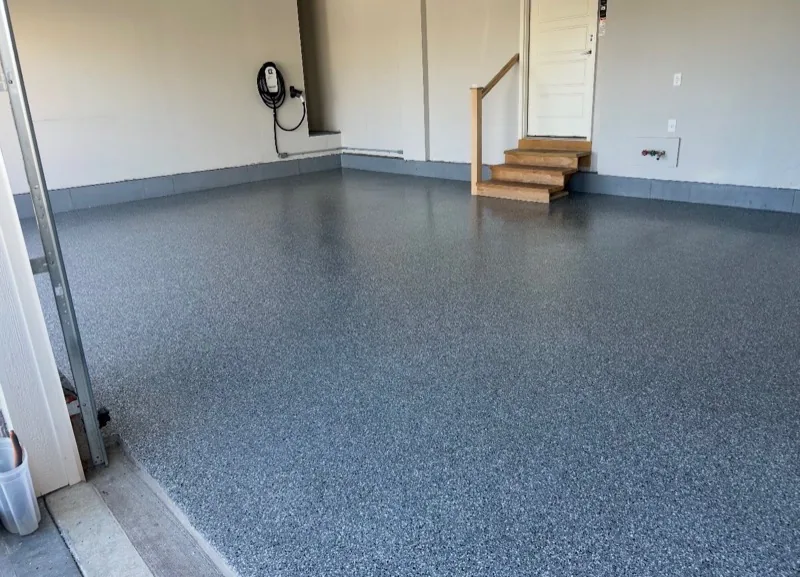
Quick answer: Most epoxy floor failures in Oregon trace back to moisture, not the product. Concrete is porous and the Willamette Valley is wet for about seven months a year; water vapor (or liquid) moves up through slabs, especially older ones with no vapor barrier, and pushes coatings off. Professionals test the slab first, with a plastic-sheet check, calcium chloride (ASTM F1869) or in-slab humidity probes (ASTM F2170), and use a moisture-mitigating primer or fix the source when readings are high.
Why moisture is the number-one enemy of coatings here
Epoxy forms a dense, nearly waterproof film. That is a strength on the surface and a risk underneath. Concrete is full of tiny pores and holds water. When a slab sits on damp soil, water vapor rises through it continuously. If a sealed film sits on top, that vapor has nowhere to go. It collects at the bond line, builds pressure, and eventually shows up as blisters, bubbles, white haze, or sheets of coating lifting from the floor.
The mid-Willamette Valley makes this worse than many places. Albany and its neighbors get roughly 40 inches of rain in a typical year, most of it from October through May. Soils around the valley floor, including the heavy clay common near the rivers, hold water. The water table rises in winter and spring. A slab that feels bone dry in August can be a different floor in February.
How moisture reaches a slab
- Vapor from the ground. Water vapor moves through concrete from wet soil beneath. Without a vapor barrier under the slab, this can be constant.
- Hydrostatic pressure. When the water table is high, liquid water can be pushed up through cracks and joints, especially near walls and low spots.
- Surface water at the door. Wind-driven rain, wet vehicles and failed door seals pond water at the threshold and edges.
- Poor drainage outside. Downspouts that dump next to a foundation, soil sloping toward the building and blocked drains raise moisture at the slab edge.
- Construction moisture. New concrete carries a lot of water and takes weeks to months to dry to a level coatings tolerate.
Vapor barriers and why older slabs are riskier
Modern building practice puts a polyethylene vapor retarder (often 10-mil plastic) over compacted gravel under a slab-on-grade. It does not make concrete waterproof, but it reduces the vapor that reaches the slab. Many older houses and shops, including a lot of the housing stock in Albany's historic districts and in rural Linn and Benton county buildings, were built before this was universal, or had their barrier damaged or omitted. Detached shops and garages added later may sit directly on soil.
If your slab has no barrier, you can still coat it, but the moisture question must be answered by testing, and you may need a moisture-mitigating primer system. It also means you should be realistic about warranties. Our framework on prep & warranty lists hydrostatic pressure and slab moisture as typical exclusions for exactly this reason, and we will say so up front.
Moisture testing: what professionals use
| Test | What it measures | Notes |
|---|---|---|
| Plastic sheet (ASTM D4263) | A quick yes/no for moisture rising to the surface | Tape a clear plastic sheet to the slab for about 16–24 hours; condensation or a dark, damp patch flags a problem. Simple screening only. |
| Calcium chloride (ASTM F1869) | Moisture vapor emission rate (MVER) at the surface, in lb per 1,000 sq ft per 24 hr | A dish of calcium chloride sits sealed under a dome for 60–72 hours and is weighed. |
| In-situ relative humidity (ASTM F2170) | Humidity inside the slab, measured with probes in drilled holes | Often preferred by manufacturers; probes equilibrate for about 24 hours. |
Commonly cited thresholds are about 3 lb MVER and about 75% internal relative humidity, but these are conventions, not law: the real limit is whatever the coating manufacturer's technical data sheet allows. Some epoxy moisture-mitigating primers are rated for much wetter slabs, in some products up to roughly 100% RH and 25 lb MVER, which is why the right product choice matters. We choose products against their published limits, not a generic number.
Signs your slab may be damp
- White, powdery deposits on the concrete (efflorescence).
- Dark patches that appear after rain or in winter and fade in summer.
- A musty smell in the garage or basement.
- Rust stains at the base of walls or on metal legs.
- Peeling paint or a failing old coating with concrete stuck to the back.
- Water tracking in at the door, cracks or the wall base after storms.
What we do about it
- Look and ask. At the estimate we inspect the slab, edges and door area, and ask about the history of the space.
- Test when warranted. A plastic-sheet check for a quick read, and more formal testing for basements, shops and anything showing warning signs.
- Fix the source when possible. Downspouts, grading, gutters, door seals and drains are cheap compared with a failed floor.
- Prime for the conditions. Grinding opens the slab; a moisture-mitigating epoxy primer can allow coating on slabs that would otherwise be too wet.
- Be honest. If a slab is too wet for a coating to last, we will say so and suggest waiting or fixing the source first, and we will not sell a floor we do not expect to survive.
Cold and damp installs
Moisture is not only about the slab. Epoxy cures best when the slab and air are comfortably above the dew point and within the product's temperature range. In cool, damp Albany winters that can be a narrow window. Condensation on a cold slab at cure time causes hazy, blushing or poorly bonded coatings. We plan around slab temperature and humidity, use heaters and ventilation, and reschedule a marginal day rather than pushing through it. For this reason, garages and shops are often best done in dry spells from late spring through early fall, though careful winter installs are entirely possible.
Why coatings fail on damp slabs: a short list
- Vapor pressure pushes the film off, causing blisters and osmotic bubbles.
- Moisture weakens the bond between primer and concrete.
- Efflorescence salts crystallize at the interface and lift the coating.
- Trapped moisture clouds clear coats and metallic pigments.
- Repeated wet-dry cycling stresses thin films, particularly at doors and edges.
All of this is why thin garage paint and DIY kits do so badly in the valley (see epoxy vs paint) and why a professional garage floor coating begins with grinding and testing. Interior slab rooms and basements are particularly exposed; see interior epoxy floors. Shops and pole-barn slabs are covered on shop & warehouse floors.
Maintenance in a wet climate
Keep gutters and downspouts clear and pointed away from the slab. Maintain the garage door bottom seal. Squeegee standing water out the door after a wet car comes in. Keep outside grade sloping away from the foundation. Sweep grit before you mop. These small habits protect any floor.
Frequently asked questions
Can you epoxy a garage floor in the rainy season in Oregon?
Yes, when the slab is dry enough and warm enough to cure properly. We test where warranted and plan around dew point and temperature. Very wet spells may need rescheduling.
How do I check if my concrete is too damp for epoxy?
A simple home check is to tape a 2-foot square of clear plastic to the floor for a day. If moisture beads underneath or the concrete darkens, the slab is passing moisture. Professional tests (ASTM F1869 or F2170) give actual numbers.
Does epoxy stop moisture coming through concrete?
Standard epoxy does not. Special moisture-mitigating primers can control vapor on many slabs, but they do not solve active water leaks or hydrostatic pressure.
What is efflorescence?
White, chalky mineral deposits left when water carries salts to the surface and evaporates. It signals moisture moving through the slab.
Is a vapor barrier under my garage slab?
Homes built to modern practice usually have one; many older homes and detached shops do not. It is often impossible to tell without records, which is why testing is the practical answer.
Related pages
Ready for a straight answer on your floor? Call or text (541) 960-4797 or send the quote form for a free on-site estimate.
Call (541) 960-4797