
Garage Epoxy vs Floor Paint: What Albany Homeowners Should Know
If your Albany garage slab is dusty, stained, or peeling from an old DIY paint job, you have probably searched for a fix that lasts. The two most common options are concrete floor paint and a professional epoxy (or polyaspartic) coating system. They look similar in a hardware-store aisle photo — but they behave very differently under Oregon rain, hot tires, and daily parking.
This guide compares both for mid-Willamette Valley conditions so you can decide with clear expectations. When you are ready for numbers, use our Albany epoxy cost guide, review prep & warranty, or call (541) 960-4797.
What “floor paint” usually means
Garage floor paints and many “1-part epoxy” kits from big-box stores are thin film coatings. They roll on like paint, dry relatively quickly, and can freshen a slab for a season or two if the concrete was clean and dry. In Albany’s wet winters, moisture vapor and residual salts often work against that thin film. Hot tires from summer highway drives can lift paint in curved tire marks — a classic failure mode homeowners call “hot tire pickup.”
Paint can still make sense for a temporary spruce-up, a low-traffic storage bay, or a budget stopgap before a full system. It rarely matches the thickness, chemical resistance, or abrasion resistance of a properly prepared multi-coat garage system.
What a real garage epoxy system includes
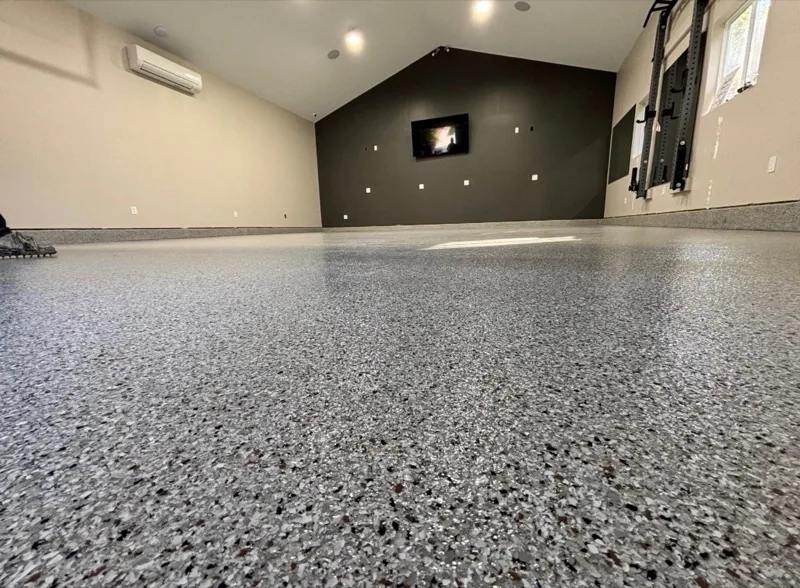
Professional garage floor coatings are not a single can of paint. A typical Albany Epoxy install includes diamond grinding (or equivalent mechanical prep), crack and joint repair, a resin base coat, optional decorative flake or metallic layer, and a clear, chemical-resistant topcoat — often polyaspartic for faster return-to-service and UV stability.
That stack is thicker and tougher than paint. It bonds into a profiled concrete surface rather than sitting on dirt and laitance. Done correctly, it resists oil, road salt tracked in from I-5, and the temperature swings Oregon slabs see between damp mornings and sun-baked afternoons.
Side-by-side: durability in Willamette Valley conditions
- Moisture & humidity: Paint films often blister when vapor pressure rises. Ground and sealed epoxy systems handle Oregon winters better when prep and moisture checks are done first.
- Hot tires: Soft paint softens further under heat and shear. Quality epoxy/polyaspartic topcoats are formulated for parked vehicles.
- Abrasion: Jack stands, tool chests, and grit from gravel driveways grind paint down. Flake systems hide wear and add texture.
- Chemicals: Battery acid, brake fluid, and degreasers stain or etch thin paint; industrial-grade topcoats shrug them off when maintained.
- Appearance: Paint shows roller marks and stains quickly. Flake and metallic finishes stay “showroom” longer with simple mopping.
Prep is the real difference (not the brand name on the can)
Whether someone rolls paint or installs epoxy, surface prep decides the outcome. Sweeping and a light etch is not the same as diamond grinding to open the concrete profile. If you already have peeling paint, that coating must be removed or the new layer will fail with it. Our prep & warranty page explains what we check on-site before we quote.
Skipping prep is why many DIY paint weekends look great on Saturday and flake by the next rainy February.
Cost: paint is cheaper up front; epoxy usually wins over time
A few gallons of floor paint cost less than a full flake system — that is honest. Re-painting every couple of years, living with tire marks, and eventually grinding off failed paint before a “real” install often costs more than doing the durable system once. Ballpark drivers (square footage, repairs, flake vs metallic, polyaspartic topcoat) are covered in the cost guide. We do not invent fixed prices online; every slab is different.
When paint might still be “good enough”
- You are selling the house in months and only need a cosmetic refresh
- The bay is rarely driven on (true storage, not daily parking)
- You accept re-coating as a recurring chore
If you park daily, work on cars, or want a floor that still looks sharp in five-plus years, epoxy (or polyaspartic) is the better investment for Albany, Corvallis, Salem, Lebanon, Millersburg, and Jefferson homes.
Common myths we hear on estimates
“All epoxy is the same.” Consumer kits and professional systems differ in solids content, pot life, and topcoat chemistry. Marketing the word “epoxy” on a paint can does not equal a multi-coat garage system.
“I can skip grinding if I use primer.” Primer helps adhesion on a clean, sound surface — it does not replace mechanical profile when the slab is sealed, painted, or glazed.
“Metallic is only for showrooms.” Homeowners use metallic epoxy in garages and shops; flake remains the workhorse for traction and hiding dirt. Commercial and interior spaces use the same prep discipline with different finish goals.
How to choose in one visit
We walk the slab, note moisture risk, existing coatings, cracks, and how you use the space. Then we recommend flake, solid, metallic, or polyaspartic options — or tell you frankly if a temporary paint refresh is all the budget allows this year. Browse the FAQ for timelines and care tips, then request a free on-site estimate.
Ready to stop re-painting and get a floor that lasts? Call (541) 960-4797 or use the quote form — Albany Epoxy serves Albany and the mid-Willamette Valley.
Call (541) 960-4797